
The de Havilland DH 106 Comet was the world's first commercial jetliner. Developed and manufactured by de Havilland at its Hatfield Aerodrome in Hertfordshire, United Kingdom, the Comet 1 prototype first flew in 1949. It featured an aerodynamically clean design with four de Havilland Ghost turbojet engines buried in the wing roots, a pressurised cabin, and large square windows. For the era, it offered a relatively quiet, comfortable passenger cabin and was commercially promising at its debut in 1952.
However, within a year problems started to emerge, with three Comets lost within twelve months in highly publicised accidents, after suffering catastrophic in-flight break-ups. Two of these were found to be caused by structural failure resulting from metal fatigue in the airframe, a phenomenon not fully understood at the time. The other one was due to overstressing of the airframe during flight through severe weather. The Comet was withdrawn from service and extensively tested. Design and construction flaws, including improper riveting and dangerous concentrations of stress around some square openings in the fuselage, were ultimately identified. As a result, the Comet was extensively redesigned, with oval windows, structural reinforcements and other changes. Rival manufacturers meanwhile heeded the lessons learned from the Comet while developing their own aircraft.
Although sales never fully recovered, the improved Comet 2 and the prototype Comet 3 culminated in the redesigned Comet 4 series which debuted in 1958 and had a productive career of over 30 years. The Comet was also adapted for a variety of military roles such as VIP, medical and passenger transport, as well as surveillance. The most extensive modification resulted in a specialised maritime patrol variant, the Hawker Siddeley Nimrod, which remained in service with the Royal Air Force until 2011, over 60 years after the Comet's first flight.
BOAC Flight 781

BOAC Flight 781 was a de Havilland Comet passenger jet operated by British Overseas Airways Corporation that on 10 January 1954 crashed into the sea near Elba Island, off the Italian coast, after suffering an explosive decompression at altitude. All 35 people on board were killed. The aircraft, registered G-ALYP, had taken off shortly before from Ciampino Airport in Rome, en route to Heathrow Airport in London, on the final leg of its flight from Singapore.
G-ALYP was the third Comet built. Its loss marked the second in a series of three fatal accidents in twelve months caused by structural failures involving the Comet, after the crash of BOAC Flight 783 near Calcutta, India, in May 1953, and followed by the loss of South African Airways Flight 201 in April 1954, crashed in circumstances similar to BOAC 781 after departing from Ciampino.
 Gerry Bull, a former BOAC engineer, said that when he inspected the
aircraft in Rome he looked for "incidental damage". He did not find any,
so he believed Flight 781 was fit for flight. Bull and the same team of
engineers later examined South African Airways Flight 201 before its final flight.
Gerry Bull, a former BOAC engineer, said that when he inspected the
aircraft in Rome he looked for "incidental damage". He did not find any,
so he believed Flight 781 was fit for flight. Bull and the same team of
engineers later examined South African Airways Flight 201 before its final flight.On January 10, 1954, Flight 781 took off from Rome at 10:31 CEST, bound for the final-stage flight to London. At about 10:50 CEST, a BOAC Argonaut, registration G-ALHJ, piloted by Captain Johnson, which was flying the same route at a lower altitude, was in contact with Captain Gibson. During a radio communication about weather conditions, the conversation was abruptly cut off. The last words heard from Captain Gibson were "George How Jig, did you get my -". Soon afterwards, fishermen saw wreckage falling into the sea.
Heathrow Airport initially listed Flight 781 as being delayed. At around 1:30 pm, the airport took the flight off the arrivals board.
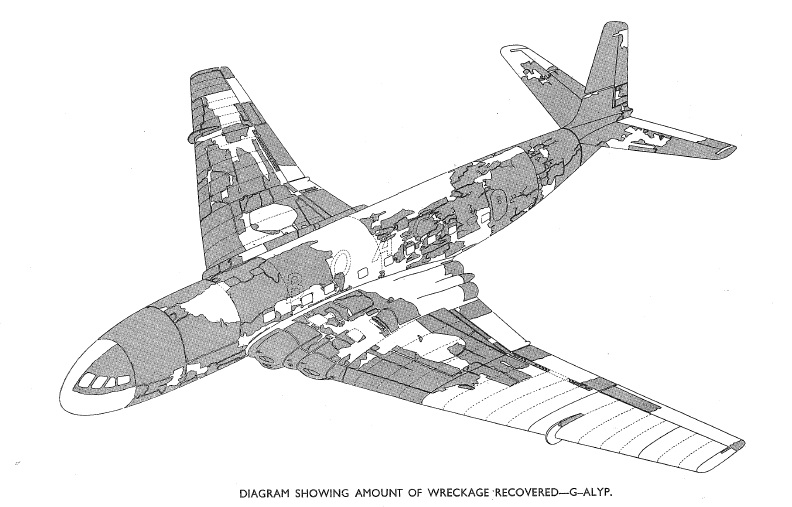 The Comet's pressure cabin had been designed to a safety factor
comfortably in excess of that required by British Civil Airworthiness
Requirements (2.5x P as opposed to the requirement of 1.33x P and an
ultimate load of 2x P, P being the cabin 'Proof' pressure) and the
accident caused a revision in the estimates of the safe loading strength
requirements of airliner pressure cabins.
The Comet's pressure cabin had been designed to a safety factor
comfortably in excess of that required by British Civil Airworthiness
Requirements (2.5x P as opposed to the requirement of 1.33x P and an
ultimate load of 2x P, P being the cabin 'Proof' pressure) and the
accident caused a revision in the estimates of the safe loading strength
requirements of airliner pressure cabins.In addition, it was discovered that the stresses around pressure cabin apertures were considerably higher than had been anticipated, especially around sharp-cornered cut-outs, such as windows. As a result, future jet airliners would feature windows with rounded corners, the curve eliminating a stress concentration. This was a noticeable distinguishing feature of all later models of the Comet.
Comentarios
Publicar un comentario